
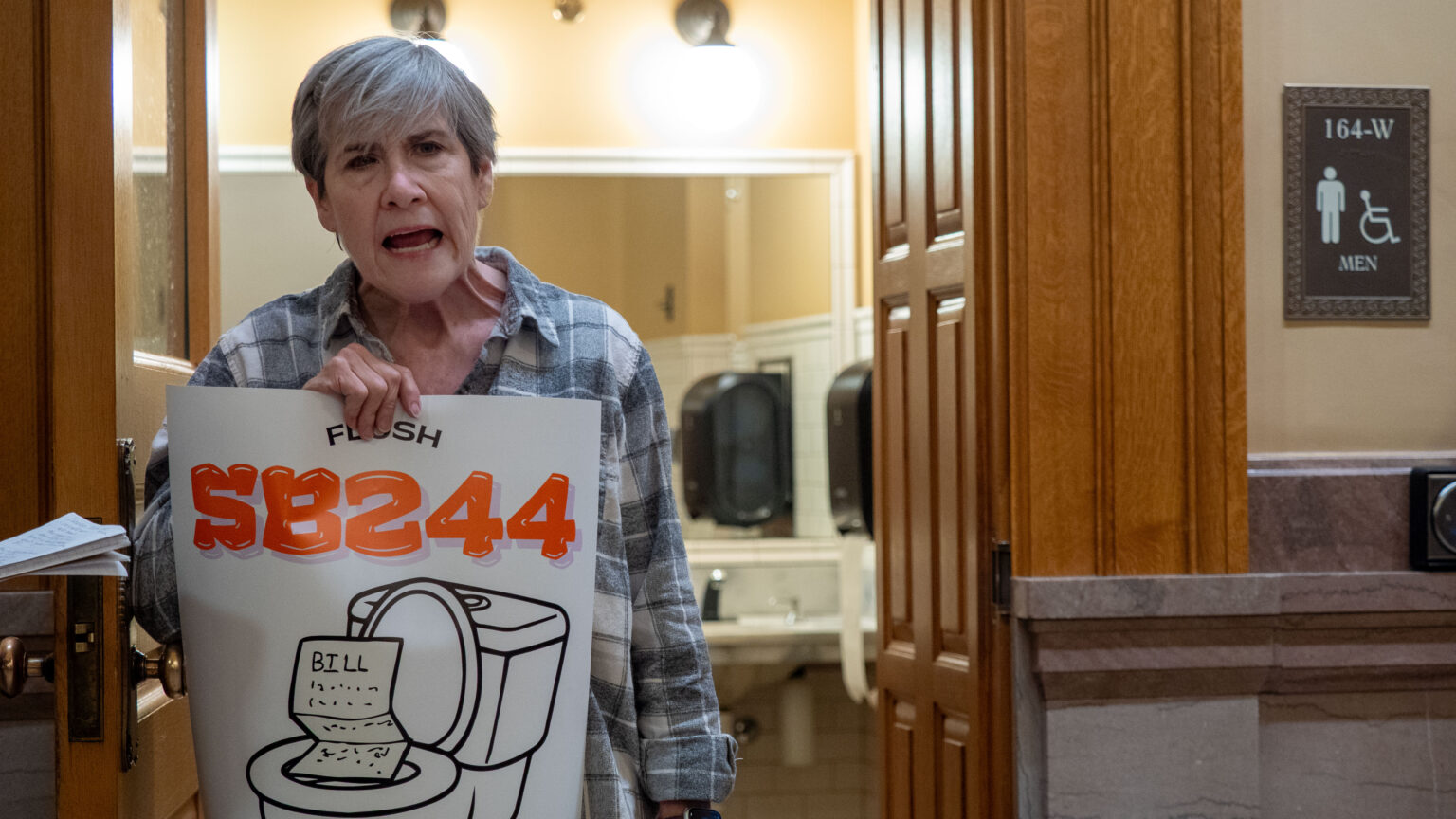
TOPEKA — State officials are delving into the language of the law that will force people to use bathroom and private facilities in government buildings that match their sex at birth, challenged by vague language that makes it difficult to know what to do.
The Kansas Department of Administration on Thursday created a new policy section to address changes that will go into effect once Senate Bill 244 is enacted. That will occur upon publication in the Kansas Register, likely within two weeks.
“The administration believed it was important to provide timely initial guidance to state agencies regarding the implementation of SB 244,” said Olivia Taylor-Puckett, spokeswoman for Gov. Laura Kelly. “Due to the vague and poorly written nature of the bill, additional guidance will be issued as logistics, administrative processes and costs are evaluated.”
SB 244 sets potentially large penalties for public agencies that don’t comply with the law, including fines of $25,000 for a first violation and $125,000 for a second violation.
In addition, it requires officials in all government buildings to create a process for investigations and hearings if someone is accused of violating the law. Those who violate the law will receive no penalty on first violation, but a penalty of $1,000 for a second violation. They could be charged with a misdemeanor crime on a third violation.
The law didn’t specify how officials would track violations and whether they would accumulate per building or across the state.
City and county attorneys would be responsible for charging violators in buildings run by their cities or counties, while the Kansas attorney general would charge violations in state buildings, according to the law.
Kansas’ bathroom law is “staggeringly broad” in scope, said Elana Redfield, federal policy director at the Williams Institute, a University of California, Los Angeles, think tank that tracks gender identity law and public policy.
Redfield said the combination in SB 244 of both restricting bathroom access and requiring gender markers on driver’s licenses and birth certificates to match sex at birth is “interesting.”
“The bill is somewhat sweeping in that it appears to require transgender people in a broad range of social contexts to be exposed or to interact with the world based on their sex assigned at birth,” Redfield said. “The downstream consequences of that for trans people are enormous. Every social interaction, you have the potential for discrimination.”
Laws like these often come from a place of fear, she said.
“I think you see that reflected in the Kansas law, which allows you to bring a claim if you are ‘aggrieved’ by the presence of somebody,” Redfield said. “What does that mean? You don’t want somebody else to be there?”
The implementation of SB 244 is “going to be interesting to watch but not very pretty,” Redfield said.
State policy
The state’s first policy statement about the law primarily describes its contents, defining what public spaces are included, specifying that the law only applies to multi-occupancy private spaces and outlining exceptions to the policy.
The state designates the secretary of the Department of Administration as the chief administrative officer of all the public buildings subject to the policy.
“Only the Secretary of the Department of Administration or their designee may receive complaints,” the policy said. “All investigations shall be conducted by the Department of Administration or state agency Human Resources staff, if designated.”
Guidance on how to submit a complaint and what the investigation process “will be forthcoming,” the policy states.