By Anna Kaminski
TOPEKA — In what founding document does the phrase “Life, Liberty, and the pursuit of Happiness” appear? Why did the United States enter the Persian Gulf War? Why do U.S. representatives serve shorter terms than U.S. senators?
These are among the 128 questions on the U.S. citizenship test, and they could become study material for Kansas students.
Under a bill that also mandates teaching students about the dangers of communism and socialism, high school freshmen would be required to take a 100-question exam based on the civics test that prospective U.S. citizens take during the American naturalization process.
Senate Bill 381 lumps the test into state-mandated American history and civics classes in public and accredited private and parochial schools, and students would have to pass the test before earning a diploma.
The bill passed the Senate on Thursday in a 26-14 vote. It also requires the State Board of Education to craft curricula that teaches K-12 public school students about “negative impacts of communist and socialist regimes and ideologies.”
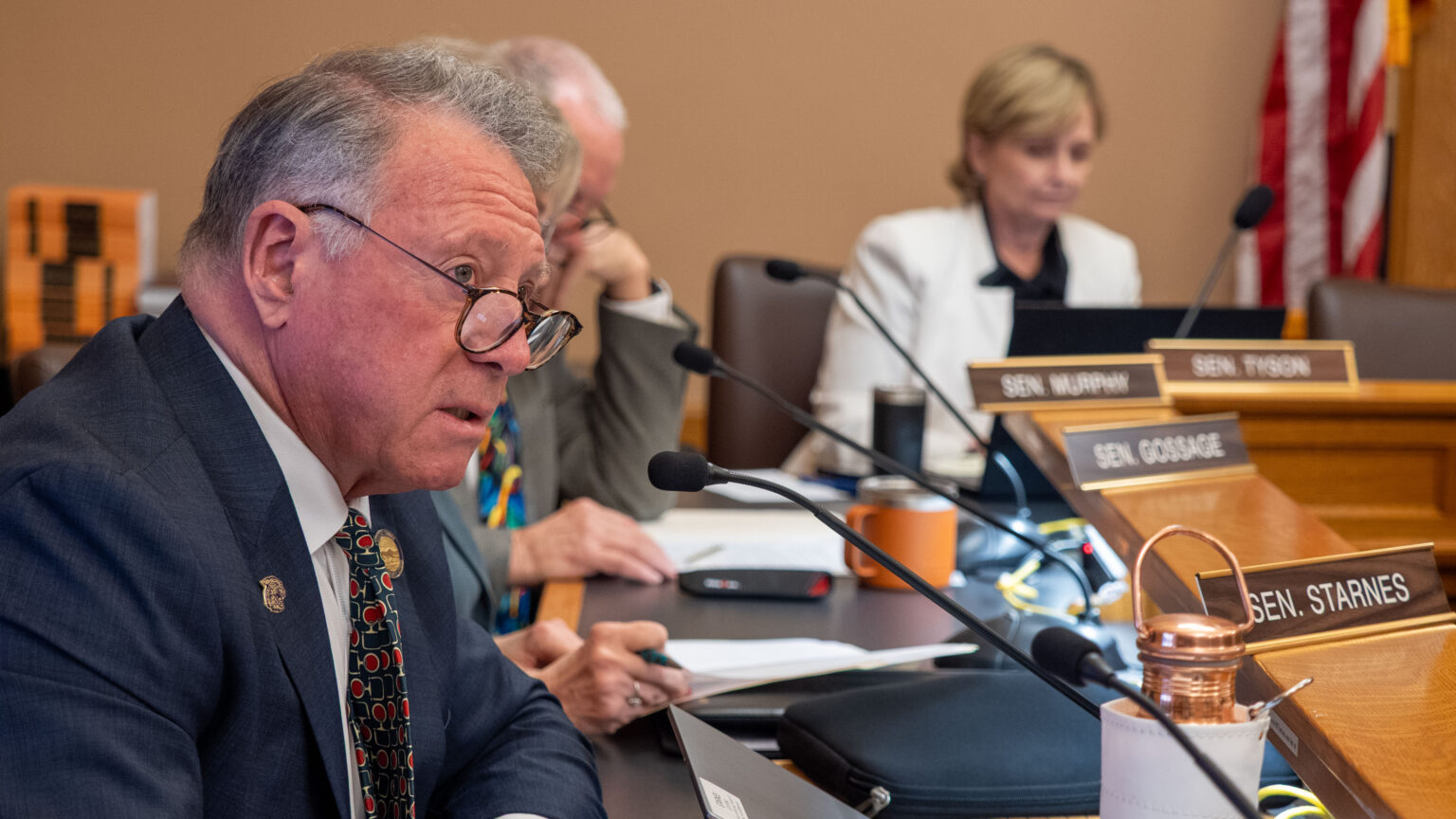
The bill is rooted in conservative circles concerned about anti-Americanism and contested statistics that purport Gen Z Americans are attracted to communist and socialist ideals. Sen. Brad Starnes, a Riley Republican and former school superintendent, put forth the bill and assured the House Education Committee on Monday that neither the civics test nor the curricula will replace existing units on American history.
Research on younger generations’ inclination toward socialist or communist causes is muddy. A 2019 Gallup poll found millennials and Gen Z, ages 18-39, view capitalism and socialism with equal favorability. As a whole, however, Americans still viewed capitalism in a more positive light than socialism.
Joshua Reynolds, a policy analyst for Cicero Action, a conservative think tank’s advocacy arm, backed the bill, citing three separate polls indicating favorable views of communism and socialism among 18-39 year olds.
Reynolds cited in testimony a 2020 poll from the Victims of Communism Memorial Foundation that “63% of Gen Z and Millennials believe that the Declaration of Independence guarantees ‘freedom and equality’ better than the Communist Manifesto, compared to 95% of the Silent Generation.”
Leah Fliter, assistant executive director of advocacy for the Kansas Association of School Boards, said socialism and communism curriculum might be inappropriate and complex for early grades.
“We feel that this bill has been drafted without looking at the Kansas state standards for graduation,” she said Monday.
The Kansas State Board of Education already recommends instruction on communism and socialism, according to Monday testimony from board members Cathy Hopkins and Beryl New. The board, they wrote, “has established history, government and social studies standards that prepare students to be informed, thoughtful, engaged citizens as they enrich their communities, state, nation, world and themselves.”
If passed, both of the bill’s provisions would go into effect July 1, making next school year’s freshmen the first group to be required to pass the civics test as a condition of graduation.
During the naturalization process, most prospective U.S. citizens must complete an interview and citizenship test, which consists of an English portion and civics portion. People must answer at least 12 of 20 civics questions correctly, which are selected at random from a cache of 128 questions about foundational American events, figures, principles and procedures. Kansas high school students would have to take a 100-question exam containing questions substantially similar to those that appear on the citizenship civics test, the bill said.
Arizona has required its high schoolers to pass a civics exam based on the U.S. citizenship test since 2017, and in 2026 raised the passing threshold, requiring students to answer at least 70 of 100 questions right instead of the original 60. Wisconsin has required the test since 2015.
Arizona only offers the test in English while Wisconsin offers versions in Spanish, Arabic, Chinese, Korean, Tagalog and Vietnamese.
The Kansas proposal does not specify a designated language. Students could request to take the test as early as seventh grade, and they can take it as many times as necessary to pass. The bill does not outline what constitutes a passing score.
