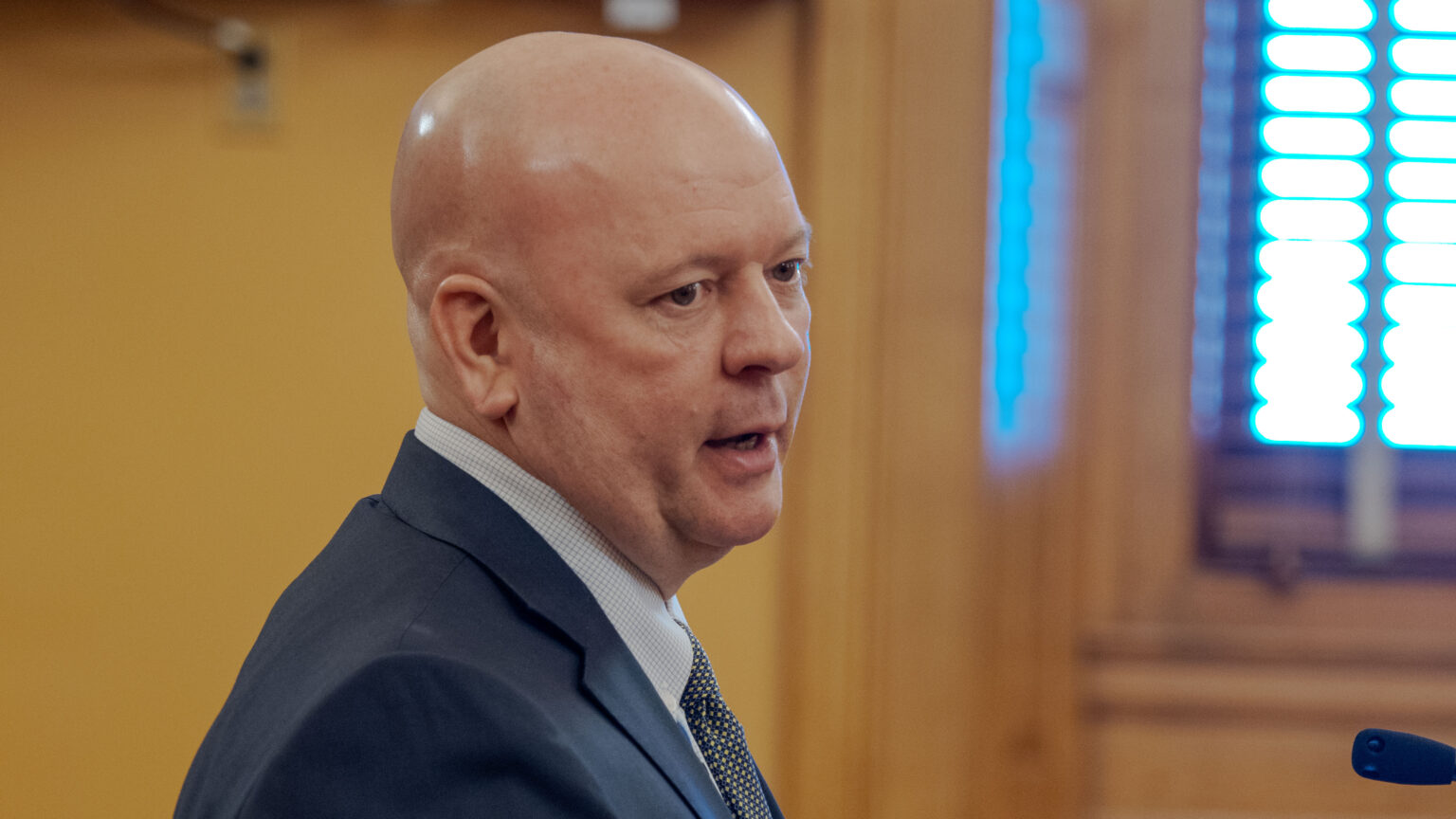
TOPEKA — A banking official told lawmakers Monday about an elderly customer who was scammed into giving tens of thousands of dollars to what she believed would be a scholarship honoring her dead husband.
Tony Weingartner, manager of the financial intelligence unit at Topeka-based Capitol Federal Savings Bank, said the bank engaged with the woman, and law enforcement and social workers met with her, but she “could not believe that that would occur illegitimately and that she was defrauded.”
“She couldn’t accept it,” he said. “And now, my understanding is, even with a conservator over her finances, she still believes that there’s a scholarship out there for her husband. There isn’t one.”
Weingartner used the anecdote to demonstrate the need for legislation that would hold telecommunications providers and social media platforms liable for fraudulent activity that results in losses for banks.
In another example, he said, the bank lost $45,000 last month after a customer was tricked by a fraudster who appeared by caller ID to be a bank employee. The customer provided account information.
The fraudster then convinced the victim’s phone service provider that the victim needed calls transferred to a new number. When the bank called to verify the legitimacy of checks from the victim’s account, fraudsters answered the phone and provided a green light.
Representatives for the banking industry appeared before a joint committee of House and Senate lawmakers to initiate conversation about House Bill 2648. The bill would require social media platforms such as Meta, which operates Facebook, to verify the identity of advertisers, give users a clear and conspicuous tool to report suspected fraud, and investigate reports of fraud within 72 hours.
Social media platforms would be liable for damages caused by fraudulent ads if they knowingly allow such ads on their platform or ignore credible reports of fraud.
The bill also would prohibit telecommunication companies from transmitting a call that falsely identifies a caller’s name or phone number.
Rep. Nick Hoheisel, a Wichita Republican who chairs the House Financial Institutions and Pensions Committee, said he wanted to hold an informational hearing on the bill, even though it won’t advance this year.
“We’re not doing anything with it,” Hoheisel said. “This is to further our understanding of financial fraud and how we can impact it here in Kansas as a committee and as a Legislature.”
She presented information she attributed to reporting by the Wall Street Journal and Reuters news service about fraudulent ads on Meta: 50% of scams for one large bank were traced to Meta, 70% of new Meta advertisers are flagged for fraud, and 96% of valid user scam reports are ignored. Additionally, she said, Meta earned $16 billion — 10% of its 2024 revenue — from ads that were scams or for banned goods. When Meta detects fraud, she said, the penalty is to charge bad actors a higher rate.
A Meta representative didn’t immediately respond to a request to comment for this story.
Megan Stokes, state policy director for the Computer and Communications Industry Association, of which Meta is a member, said in written testimony that the bill is unconstitutional because it regulates interstate services that are under federal domain and would criminalize protected free expression in violation of the First Amendment.
She objected to a private right of action in the bill that would allow individuals to sue companies for violations. She predicted courthouses would be flooded with “frivolous claims with little evidence of actual injury.”
Gerry Keegan, who represents CTIA, a trade association for the wireless industry, said telecommunication providers share a goal of protecting residents from fraud. They are actively developing new technology, he said, including an effective framework called “STIR/SHAKEN,” to combat bad actors.
“This legislation would impractically and improperly establish that providers of voice and messaging services would be liable for the actions of bad actors on their networks,” Keegan said. “While well-intentioned, this legislation would do little to deter bad actors who are already violating existing laws and would instead impose new requirements on law-abiding companies who are hard at work in the fight against unwanted and illegal robocalls and texts.”
