
By Morgan Chilson
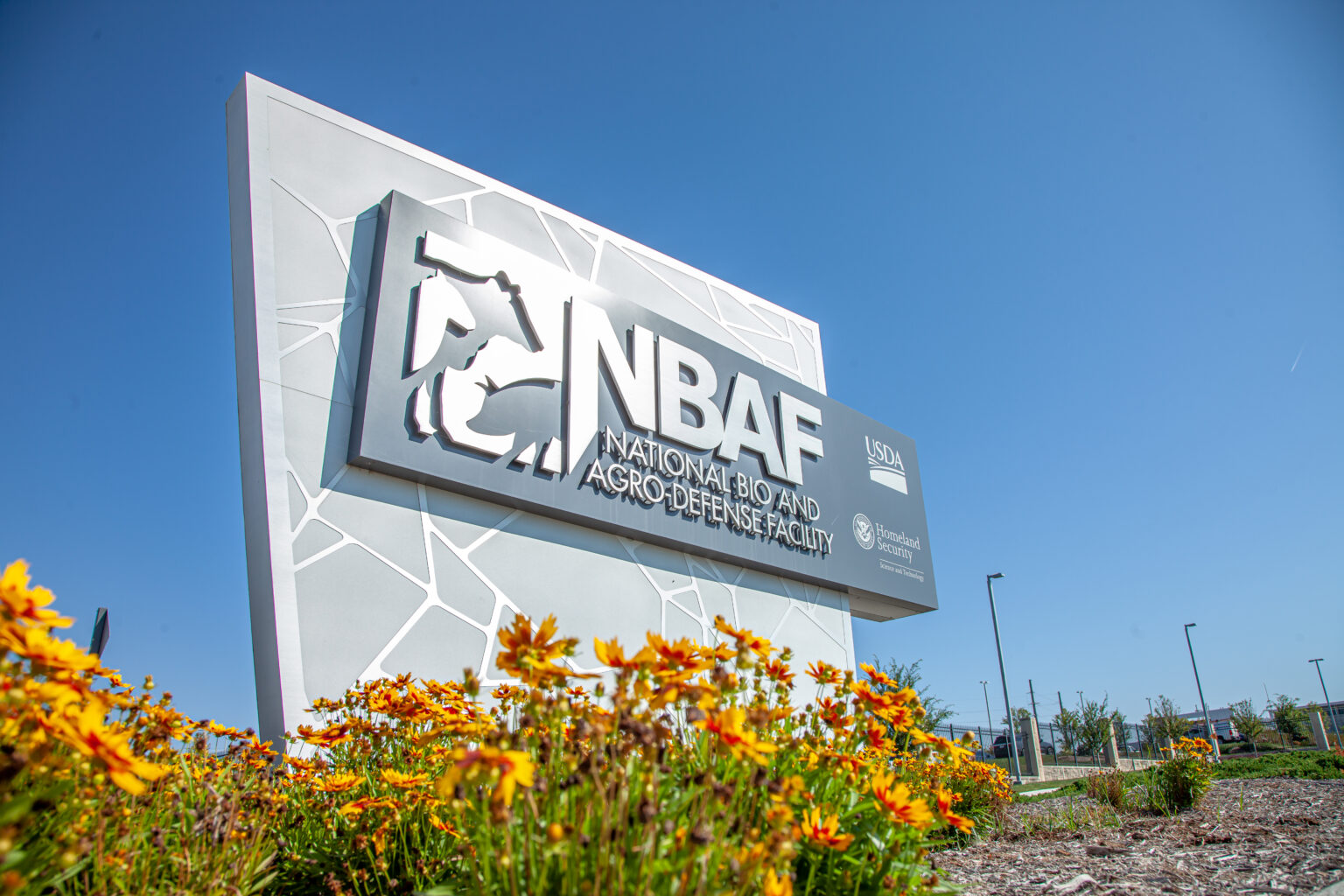
The $1.25 billion biocontainment facility in Manhattan developed for cutting-edge research on the most dangerous animal diseases is not fully operational three years after its ribbon-cutting, a federal report determined.
The Office of Inspector General published a July report stating the National Bio and Agro-Defense Facility isn’t able to perform the high-level animal disease science it was designed for.
The facility wasn’t appropriately configured by the U.S. Department of Homeland Security, the report said.
DHS transferred the facility to the U.S. Department of Agriculture in February 2024, which accepted it without a complete commissioning report, a move that ultimately cost the USDA $75.8 million as it fixes issues that hadn’t been addressed, the report said.
The USDA expects additional costs may be incurred to finish the 574,000-square-foot facility.
The OIG report recommended multiple steps to bring the facility to full operational status, including repairs and upgrades to configure spaces to appropriately house animals and completing the commissioning process that allows the facility to handle dangerous diseases.
NBAF was built to replace New York’s Plum Island Animal Disease Center, where the USDA conducted high-level animal disease research. Plum Island was billed on its website as “the nation’s premiere defense” against accidental or intentional introduction of animal diseases into the United States.
It was considered a coup for Kansas when Manhattan was selected as the site for the facility in 2009, and a groundbreaking was held in 2015 for the laboratory. The facility was expected to employ about 325 permanent workers and to have a $3.5 billion economic effect on the state in its first 20 years of use, according to a 2015 announcement from Kansas State University.
The state committed $105 million in matching state funds to NBAF and $35 million of research funding, the announcement said.
In May, NBAF director Alfonso Clavijo told the Greater Manhattan Area Chamber of Commerce that the lab would soon be hiring 150 people, to bring total employees to about 400.
NBAF was designed to handle large animals in areas that allowed for high-level containment to study hazardous diseases, the report said.
The facility is meant to support research at multiple biosafety levels, ranked from BSL-1, which allows scientists to work with microbes and biological agents that are considered minimal biosafety hazards, up to BSL-4, which are rated as dangerous, the report said.
Currently, NBAF is operating its BSL-1 and -2 levels but is not operating the BSL-3 and -4, which require “more robust protective and decontamination equipment, and being airtight under certain circumstances (BSL-3) or always (BSL-4),” the report said.
DHS said the commissioning process was finished and distributed a commissioning report to USDA in July 2023, but the USDA knew there were deficiencies in the facility, the OIG report said.
In May 2023, the USDA asked an outside organization for an independent review. Issues discovered in the facility include air supply continuity issues, problems with sealing rooms and lack of gates to keep animals from moving around.
USDA said in a response to the report that it will have the BSL-3 lab operational by the end of 2026 but didn’t set a date to open the BSL-4 lab.
The NBAF communications department did not immediately answer phone and email requests about how research on animal diseases was affected by the delay between closing Plum Island and getting NBAF labs operational.
